Luxury packaging is more than just a box. It represents your brand, protects your product, and creates a memorable first impression. Behind every premium rigid box is a carefully controlled manufacturing process that combines engineering, craftsmanship, and high-quality materials.
Unlike folding cartons, rigid boxes are built from thick greyboard that cannot be folded flat after production. Each box passes through multiple production stages to ensure strength, accuracy, and a flawless finish.
In this guide, we'll walk you through the complete rigid box manufacturing process and explain what makes premium rigid boxes different from ordinary packaging.
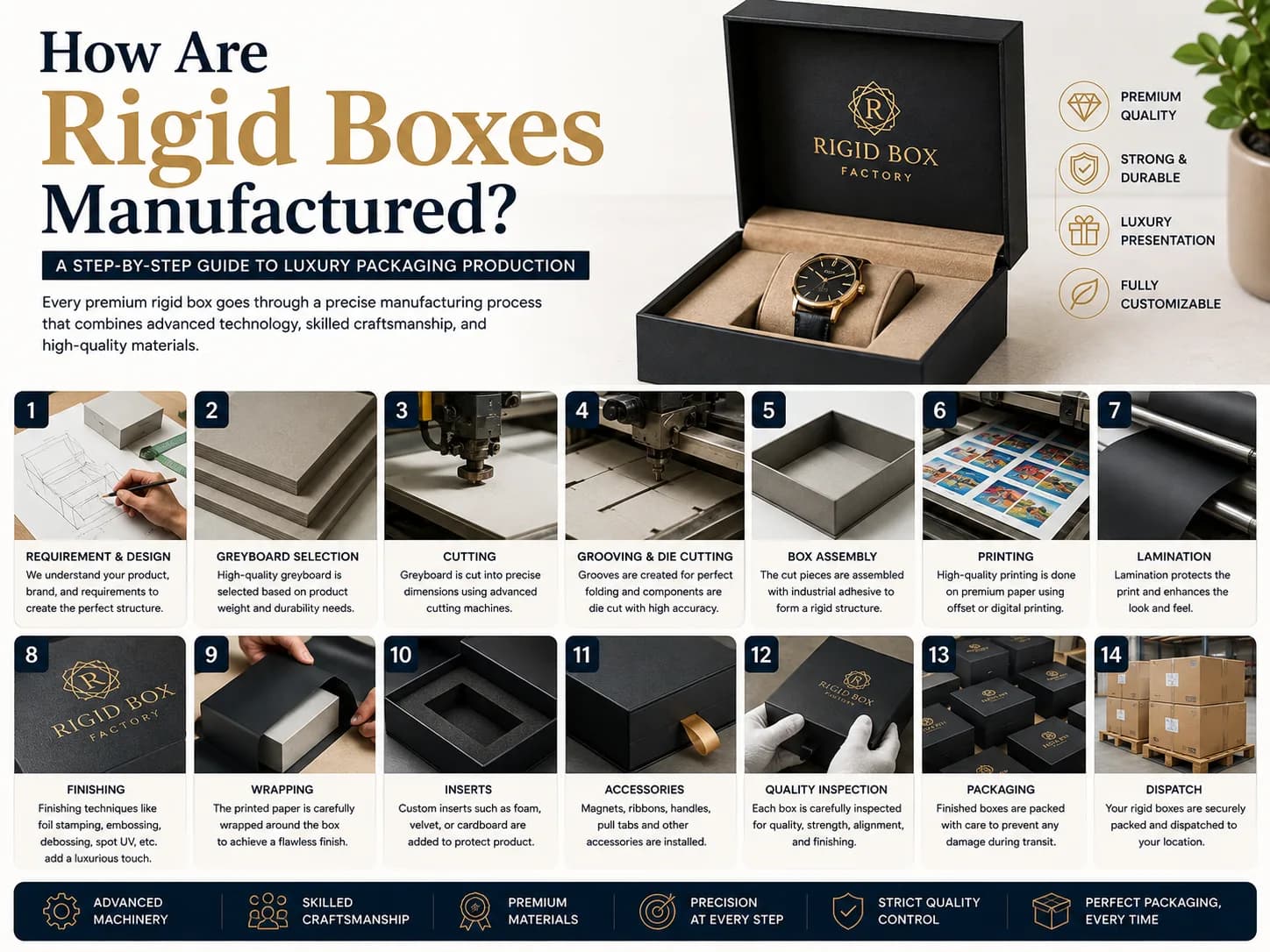
What Makes a Rigid Box Different?
Rigid boxes are manufactured using thick paperboard, commonly known as greyboard, which gives the box its strength and durability.
Unlike standard carton packaging, rigid boxes are:
- Strong and durable
- Premium in appearance
- Reusable
- Highly customizable
- Suitable for luxury products
- Designed for an exceptional unboxing experience
Because they involve multiple manual and automated production stages, rigid boxes require significantly more precision than standard folding cartons.
Step 1: Understanding the Product Requirements
Every successful packaging project begins with understanding the product.
Before manufacturing starts, the packaging team evaluates:
- Product dimensions
- Product weight
- Fragility
- Target market
- Branding requirements
- Shipping method
- Storage conditions
- Budget
These details determine the appropriate box style, board thickness, inserts, and finishing options.
Step 2: Structural Design
Packaging engineers create the structural design using specialized CAD software.
During this stage, they define:
- Box dimensions
- Lid height
- Base height
- Material thickness
- Fold lines
- Product fit
- Insert placement
- Opening mechanism
The objective is to ensure the product fits securely while maintaining an elegant presentation.
Step 3: Selecting the Right Greyboard
Greyboard forms the foundation of every rigid box.
Manufacturers choose the board thickness based on the product's weight and required durability.
Common greyboard thicknesses include:
- 1.2 mm
- 1.5 mm
- 2.0 mm
- 2.5 mm
- 3.0 mm
Heavier products require thicker greyboard to maintain structural integrity.
Step 4: Cutting the Greyboard
Once the material is selected, the greyboard sheets are cut into precise dimensions using automated cutting machines.
Accuracy is essential because even a small variation can affect the final fit of the box.
Quality checks at this stage ensure:
- Clean edges
- Accurate dimensions
- Smooth surfaces
- Consistent thickness
Step 5: Grooving and Die Cutting
The cut greyboard passes through grooving machines.
Grooves create precise fold lines that allow the board to bend neatly without cracking.
Die cutting ensures all components fit together perfectly during assembly.
This stage directly affects:
- Box alignment
- Lid fit
- Overall appearance
- Structural strength
Step 6: Box Assembly
The grooved pieces are assembled into the desired box shape using industrial adhesives.
Depending on the box style, the assembly may include:
- Base
- Lid
- Inner shoulder
- Hinges
- Sleeves
- Trays
Many premium rigid boxes still involve skilled manual assembly to achieve precise corners and flawless finishing.
Step 7: Printing the Wrapping Paper
While the box structure is being assembled, the outer wrapping paper is printed separately.
Popular printing methods include:
Offset Printing
Ideal for high-quality graphics and large production runs.
Digital Printing
Suitable for prototypes, short runs, and personalized packaging.
Screen Printing
Often used for textured papers and specialty finishes.
The printed artwork typically includes:
- Brand logo
- Product details
- Graphics
- Colors
- Patterns
- QR codes (if required)
Step 8: Lamination
Lamination protects the printed surface while enhancing its appearance.
Common options include:
Matte Lamination
Creates a smooth, elegant finish.
Gloss Lamination
Produces a shiny, vibrant appearance.
Soft Touch Lamination
Offers a luxurious velvet-like texture that is popular among premium brands.
Anti-Scratch Lamination
Improves durability by reducing visible scratches during handling.
Step 9: Premium Finishing Techniques
Luxury packaging often includes decorative finishes that make the box stand out.
Hot Foil Stamping
Metallic foil is applied using heat and pressure to create eye-catching logos and text.
Available colors include:
- Gold
- Silver
- Rose Gold
- Copper
- Holographic
- Black
Embossing
Raises selected elements above the paper surface, creating a tactile effect.
Debossing
Presses the design into the surface, creating depth and sophistication.
Spot UV
Adds a glossy coating to specific design elements, creating contrast against matte backgrounds.
Screen Printing
Ideal for specialty inks, metallic effects, and textured surfaces.
These finishing techniques enhance both visual appeal and perceived product value.
Step 10: Wrapping the Box
One of the most critical stages is wrapping.
The printed paper is carefully applied around the assembled greyboard using specialized machinery and skilled operators.
During wrapping, the paper must be:
- Perfectly aligned
- Bubble-free
- Wrinkle-free
- Smooth around all edges
- Neatly folded at the corners
This step largely determines the final appearance of the box.
Step 11: Adding Inserts
Many rigid boxes include custom inserts to protect and display the product.
Common insert materials include:
- EVA Foam
- Velvet Foam
- Satin Fabric
- Cardboard Inserts
- Molded Pulp
- Paper Inserts
- Plastic Trays (where appropriate)
Well-designed inserts improve product presentation while preventing movement during transport.
Step 12: Installing Accessories
Premium packaging often includes additional features such as:
- Magnetic Closures
- Satin Ribbons
- Pull Tabs
- Handles
- Elastic Bands
- Decorative Metal Plates
These accessories enhance functionality and create a more luxurious unboxing experience.
Step 13: Quality Inspection
Before packaging and shipping, every batch undergoes quality control.
Inspectors evaluate:
- Dimensions
- Printing quality
- Color consistency
- Surface finish
- Corner alignment
- Glue adhesion
- Magnet performance
- Insert fit
- Structural strength
Only boxes that meet quality standards proceed to final packaging.
Step 14: Packaging and Dispatch
Finished rigid boxes are packed carefully to prevent damage during transportation.
Depending on the box style, manufacturers may use:
- Protective wrapping
- Cartons
- Corner protectors
- Pallets
- Stretch film
Proper packaging ensures the boxes reach customers in excellent condition.
Machines Used in Rigid Box Manufacturing
A modern rigid box manufacturing facility may use equipment such as:
- Greyboard Cutting Machine
- Grooving Machine
- Die Cutting Machine
- Corner Pasting Machine
- Box Forming Machine
- Wrapping Machine
- Foil Stamping Machine
- Embossing Machine
- Spot UV Machine
- Screen Printing Machine
- Quality Inspection Equipment
While automation improves efficiency, skilled craftsmanship remains essential for producing premium rigid boxes.
Factors That Affect Manufacturing Quality
Several factors influence the final quality of a rigid box:
- Greyboard quality
- Printing accuracy
- Wrapping precision
- Adhesive quality
- Lamination type
- Finishing techniques
- Machine calibration
- Skilled workmanship
- Quality control procedures
A small mistake at any stage can affect the overall appearance and performance of the finished box.
Why Precision Matters
Luxury packaging represents your brand before the customer even sees the product.
Well-manufactured rigid boxes:
- Build trust
- Increase perceived product value
- Protect the contents
- Improve customer satisfaction
- Encourage repeat purchases
- Enhance the unboxing experience
- Strengthen brand recognition
Investing in quality manufacturing helps ensure that your packaging reflects the quality of your products.
Frequently Asked Questions
What material is used to manufacture rigid boxes?
Rigid boxes are primarily made from thick greyboard wrapped with printed or specialty paper. Additional materials such as foam, fabric, magnets, and ribbons may be added depending on the design.
Are rigid boxes handmade?
Most rigid boxes are produced using a combination of automated machinery and skilled manual craftsmanship. Processes such as wrapping, assembly, and quality inspection often require experienced operators.
How long does it take to manufacture custom rigid boxes?
Production time depends on the box style, order quantity, materials, and finishing options. Sampling and approvals also affect the overall timeline.
Can rigid boxes be customized?
Yes. Almost every aspect of a rigid box can be customized, including its dimensions, structure, materials, printing, inserts, and decorative finishes.
Why do luxury brands prefer rigid boxes?
Rigid boxes provide excellent protection, premium aesthetics, and an exceptional unboxing experience, making them a preferred choice for luxury products.
Why Choose Rigid Box Factory?
At Rigid Box Factory, we combine advanced manufacturing equipment with skilled craftsmanship to produce high-quality custom rigid boxes for businesses across India and international markets.
From structural design and material selection to printing, finishing, and quality control, every box is manufactured with precision to meet the highest standards of luxury packaging.
Whether you need jewellery boxes, magnetic closure boxes, cosmetic packaging, perfume boxes, gift boxes, or fully customized rigid packaging, our team can help you create packaging that reflects the quality of your brand.